Figure IV.4.4: Example of definition of data for the calculation of different types of strength
ratio envelopes.
In the post-processing example, all the outputs are saved in a single SQLite database. Some of the results can be accessed interactively via “SQLiteAdmin” program. This is for example the case for the excel-like tables in the database. SQLiteAdmin program allows to create views, export tables or views in excel. This means that part of the results saved in the database can directly be used to assess structure performance.
On the other hand, the “StrengthRatios” SQLite table, stores results in BLOB objects, and these cannot be visualized without specific conversion. One provides in the example, a ruby “‘final.rb” script that manipulates StrengthRatios content and performs the following operations:
Calculation of strength ratios corresponding to envelopes of load cases. This is done by calculation of maximum strength ratios for selection of load cases. Then, the envelope of strength ratios are also saved in the SQL database. Three type of envelopes are supported:
The “ENV” type of envelope calculates an envelope considering the maximum SR values for several load cases.
The “SUM” envelope calculates the summation of several envelopes. Typically the terms of this summation correspond to envelopes:
This is a first way to conservatively assess strength for a combination of different environments (thermoelastic and mechanical, for example).
When environments are not corelated, one sometimes calculates a RSS combination of results:
The post-processing provides an example of this kind of combination. The construction of envelopes is done in “final.rb” by calling method “buildSrEnvelopes”. Among other things, this method reads file “DATA/CSV_LC/EnvSum.csv” that defines, column by column, the different envelopes tha must be calculated. Figure IV.4.4 shows an example of Excel data definition.
One can also extract strength ratios, and produce Gmsh files corresponding to the different failure modes and split them according to groups corresponding to interfaces, parts... This is done by calling “outputSlpitGmsh” method in “final.rb”. This method looks as follows:
          def outputSlpitGmsh(db3)
              dblcCsvFiles="DATA/CSV_GMSH_SPLIT/load_cases_split_A.csv"
              femsplitCsvFile="DATA/CSV_GMSH_SPLIT/SR_split_A.csv"
              Manips::splitGmshFiles(db3,dblcCsvFiles,femsplitCsvFile)
          end
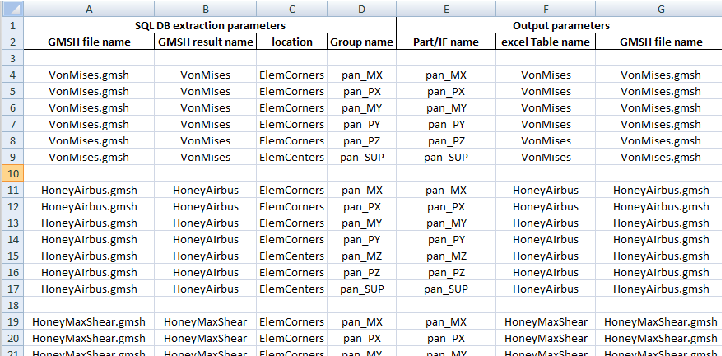
Examples of data defining the splitting to GMSH files are shown in Figures IV.4.5 and IV.4.6. Parameter “location” in column “C” deserves additional explanation as it influences both the extraction of SR results, and the GMSH Results output.
Finally, when strength ratios have been produced by summing several envelopes, it is no longer possible to find an excel table corresponding to the critical margin of safety on a selected area in the structure. On the other hand, margin of safety can be estimated from the maximum strength ratio. “sr2xl” method performs this operation and saves the critical margins of safety in “xl_from_sr” table in SQLite database.
Several of the methods called by “final.rb” script are programmed in “Manips” module stored in “PGR/manips.rb” file. (This file has been recently displaced from “DATA" to “PGR” directory.)

| location | SQLite DB key | Result Extraction method | Gmsh output location |
| ElemCenterPoints | ElemCenterPoints | ElemCenters | ElemCenterPoints |
| Elements | Elements | ElemCorners | Elements |
| ElemStations | ElemCenterPoints | Elements | ElemNodePoints |
| NodesOnly | NodesOnly | NodesOnly | Nodes |
| Nodes | Nodes | Nodes | Nodes |