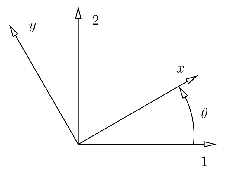
II.1.2 Rotation in XY plane and algebraic notations
A common operation in classical laminate analysis is to rotate vectors, tensors and matrices. The
operations used in the rest of this Chapter and in FeResPost are summarized here. This rotation is
represented in Figure II.1.3.
II.1.2.0.1 Rotation of base vectors
For such a rotation, the vectors
and are expressed
as a function of
and as:
|
|
To simplify the notations, the symbols
and are
introduced. It is also preferable to write the more general 3D version of the transformation:
|
| (II.1.1) |
The inverse relation corresponds to a rotation of angle
and is
obtained by changing the signs of the sines in the rotation matrix:
|
| (II.1.2) |
II.1.2.0.2 Transformation of vector and tensor components
The expressions (II.1.1) and (II.1.2) can be used to transform the components of vectors. For example:
|
| (II.1.3) |
For the transformation of 2D tensors, the transformation matrix is used twice. For example, a
Cauchy stress tensor is transformed as follows:
|
| (II.1.4) |
II.1.2.0.3 Matricial notations
As the Cauchy stress tensor is symmetric, expression (II.1.4) is more conveniently written in a
matricial form as follows:
|
| (II.1.5) |
The same expression applies to the components of the strain tensor, which is also symmetric:
|
|
However, classical laminate analysis is conventionally written using angular shear components for
the strain tensor:
Using the angular components, the matricial expression to be used for the rotation becomes:
|
| (II.1.6) |
An interesting aspect of the transformations (II.1.5) and (II.1.6) is that the transformation can be
applied separately to sub-groups of components:
-
For the in-plane components, the following transformations apply:
|
| (II.1.7) |
|
| (II.1.8) |
-
For the out of plane shear, the transformation is:
|
|
The relation has been written for the out-of-plane shear components of strain tensor. Note
however, that the relation is the same for the out-of-plane shear components of Cauchy stress
tensor.
-
The
or
component is left unchanged.
This helps justify some of the simplifications of the classical laminate analysis; among others,
the decoupling of in-plane and flexural deformation of the laminate on one hand from
the out-of-plane shear on the other hand. The third direction is systematically neglected:
. The
inverse of relation (II.1.7) is:
|
| (II.1.9) |
|
|
II.1.2.0.4 Introduction of a short notation
In order to simplify the notations, the following are introduced:
|
|
|
|
|
|
|
|
|
| (II.1.10) |
These matrices are not independent. For example:
|
|
|
|
|
|
|
|
The transformations of the components of strain tensor (II.1.8) and stress tensor (II.1.9) are then
written:
|
|
|
|
|
|
Similarly, for the out-of-plane shear stresses and strains, the following relations hold:
|
|
|
|
|
|
|
|